Hospitals are under increasing pressure to deliver high-quality patient care while also juggling the task of managing rising demands, staffing shortages and growing operational costs.
Hospital autonomous mobile robots (AMRs) are one of the most significant innovations that are currently helping healthcare providers to improve operational efficiency while allowing clinical staff to spend more time actually caring for their patients.
AMRs in hospitals are already being deployed across healthcare facilities worldwide to automate the transportation of medicines, supplies, laboratory samples and waste. In this article, we examine how hospital autonomous mobile robots are transforming logistics and supporting more efficient healthcare operations.
What are autonomous mobile robots (AMRs)?
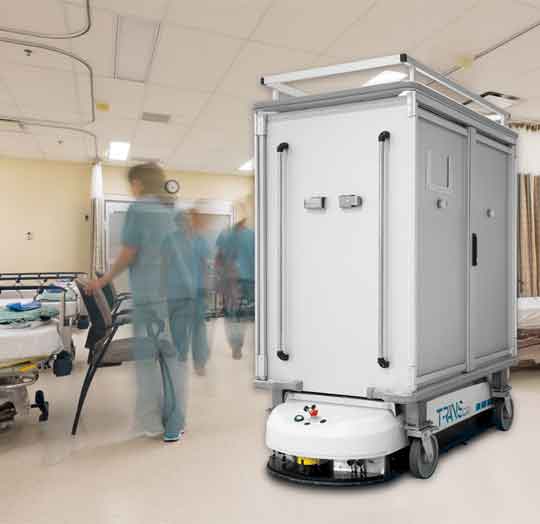
Autonomous mobile robots (AMRs) are intelligent robotic transport systems that can move materials independently throughout a building like a hospital. They use sensors, cameras and onboard software to understand their surroundings and navigate dynamically rather than following fixed routes. They can detect and safely avoid people and obstacles and continuously optimise their routes as conditions change.
The main difference between AMRs and Automated Guided Vehicles (AGVs) is that AGVs generally follow predefined routes using infrastructure such as magnetic strips, wires or reflectors, whilst AMRs create their own routes using mapping and navigation technology.
AMRs are much easier to introduce into existing hospital environments because they require little or no additional floor infrastructure. This flexibility is particularly valuable in busy hospitals where layouts, priorities and traffic constantly change. AMRs can also integrate into wider hospital logistics systems, supporting efficient movement between departments.
While hospital logistics is under pressure
Modern hospitals face growing operational challenges beyond direct patient care. This is largely linked to NHS staffing shortages and ongoing recruitment difficulties, creating increasing pressure on existing healthcare teams.
When this is coupled with increasing patient numbers, ageing populations and growing demand for diagnostic and treatment services, nurses, porters and other healthcare professionals frequently end up spending valuable time transporting items around the hospital instead of carrying out clinical duties.
They can often be found moving medicines, linen, samples, sterile equipment, clinical supplies and waste, and while these journeys are essential, they are also repetitive and time-consuming. Every minute that is spent transporting these supplies is time that cannot be spent delivering patient care, so automation can reduce this operational burden without compromising service quality.
 How AMRs are used in hospitals
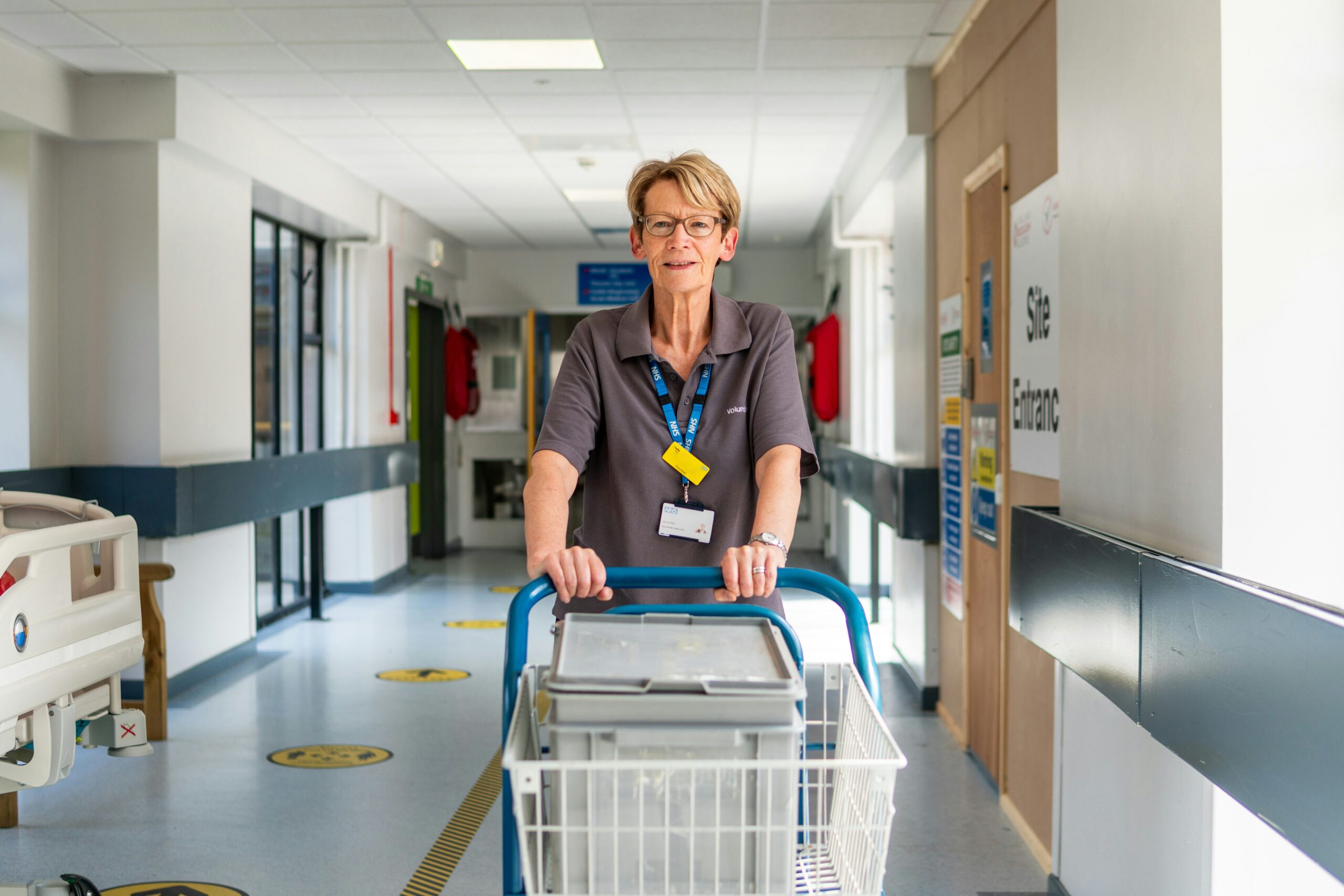 How AMRs are used in hospitals
Hospital AMRs can support multiple departments by automating routine transport tasks across healthcare facilities.
Medication delivery
Pharmacies often need to supply medicines to multiple wards quickly and accurately. AMRs can be used to transport pharmacy stock, patient prescriptions, controlled drugs in secure access control compartments, and emergency medications. This can lead to faster deliveries and reduced interruptions for nursing staff, as well as improved inventory movement and better availability of medicines.
Laboratory sample transportation
Rapid and reliable sample transport is vital in supporting diagnosis and treatment. Blood, tissue and urine samples as well as diagnostic specimens need to be moved quickly and safely. AMRs can provide scheduled or on-demand transport between wards, laboratories and pathology departments, helping to reduce delays while supporting consistent sample handling and traceability.
Linen and laundry logistics
Clean and used linen will also be continually moved throughout hospitals. AMRs can help to deliver clean bedding and uniforms, collect soiled linen and transport laundry between departments. This automation supports efficient stock replenishment and helps to maintain infection prevention procedures by reducing any unnecessary manual handling.
Sterile equipment delivery
Operating theatres and clinical departments depend on the reliable delivery of sterile equipment. This includes the transportation of sterile instrument sets, surgical instruments, sterile packs and theatre equipment. Reliable automated delivery can help to ensure the equipment is available whenever it is required while reducing delays to surgical schedules.
Waste collection and disposal
Hospitals generate multiple waste streams, each requiring careful handling. AMRs can transport clinical waste, general waste, hazardous materials, and recycling. Automation therefore limits unnecessary staff contact with waste while supporting safe and efficient waste management procedures.
The benefits of autonomous mobile robots in healthcare
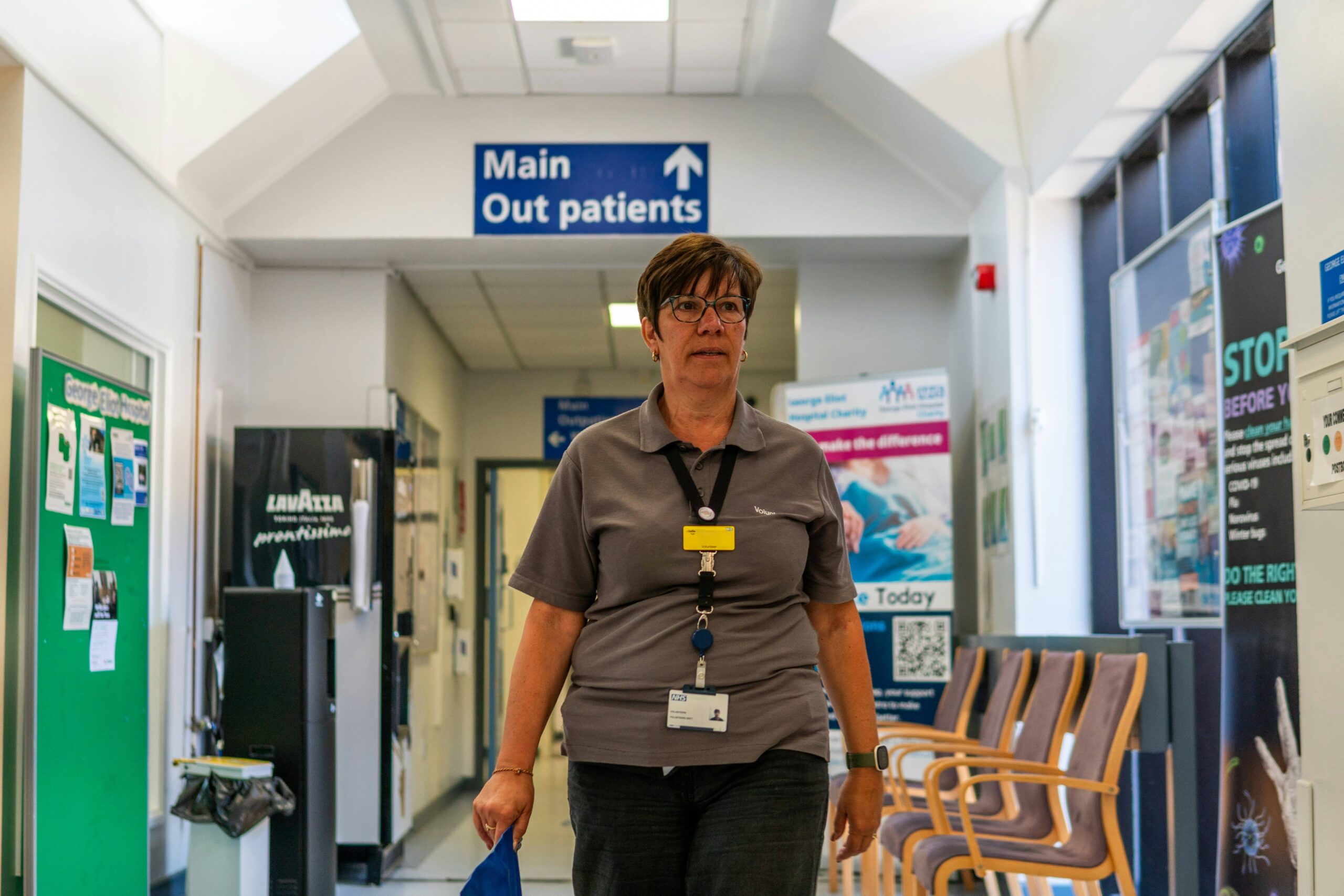
AMRs can automate repetitive, low-value transport tasks, which frees up nurses, biomedical scientists, porters and healthcare professionals to spend more time on patient-focused responsibilities. This helps hospitals to make better use of limited staffing resources and supports workforce resilience during periods of high demand.
It can also lead to enhanced patient care thanks to the faster movement of medicines, samples and equipment to reduce delays across clinical workflows. This can help clinicians to access the resources they need more quickly and supports faster diagnosis and treatment.
Manual transportation also reduces unnecessary person-to-person contact, which minimises the opportunities for cross-contamination. It can support established hospital hygiene and infection prevention protocols and provide more consistent handling procedures for sensitive items.
Automation can also improve the operational efficiency of a hospital, rather than simply replacing staff. This is because it reduces the time spent on repetitive transport activities, enabling hospitals to make better use of existing resources. This can deliver long-term return on investment through increased productivity and more efficient workflows.
Hospital logistics continue around the clock, and AMRs can operate continuously without fatigue, delivering consistent service regardless of shift patterns. This reduces the dependence on staffing availability for routine transport tasks and helps to maintain reliable logistics during busy periods or workforce shortages.
If you would like to see how automated transport systems are already supporting UK hospitals, take a look at our Southmead Hospital case study, where Aerocom restored a critical AGV installation that continues to support day-to-day hospital logistics.
The adoption of hospital autonomous mobile robots is being driven by growing patient demand, workforce pressures and increasingly complex hospital logistics. These hospital AMRs can automate routine transport tasks, improve staff productivity, support infection control and help healthcare professionals to spend more time delivering patient care.
As hospitals continue to modernise, AMRs are becoming a practical solution for improving efficiency without compromising on clinical standards.
Take a look at Aerocom’s Hospital Autonomous Mobile Robot solutions to discover how automation can improve hospital logistics, workflow efficiency, and patient care.