Autonomous mobile robots (AMRs) are self-navigating robotic vehicles designed to move materials, products and equipment around facilities with minimal human intervention. Unlike traditional automated systems, AMRs do not rely on fixed routes, floor markings or guide wires. Instead, they can understand their surroundings, make navigation decisions, and adjust their routes in real time.
As businesses seek greater efficiency and productivity, AMRs are becoming a key part of warehouse and manufacturing automation. Although often discussed alongside automated guided vehicles (AGVs), the technologies operate differently. Here, we explain how AMRs work, where they are used and why adoption is growing.
How autonomous mobile robots work
Mapping and multi-technology navigation
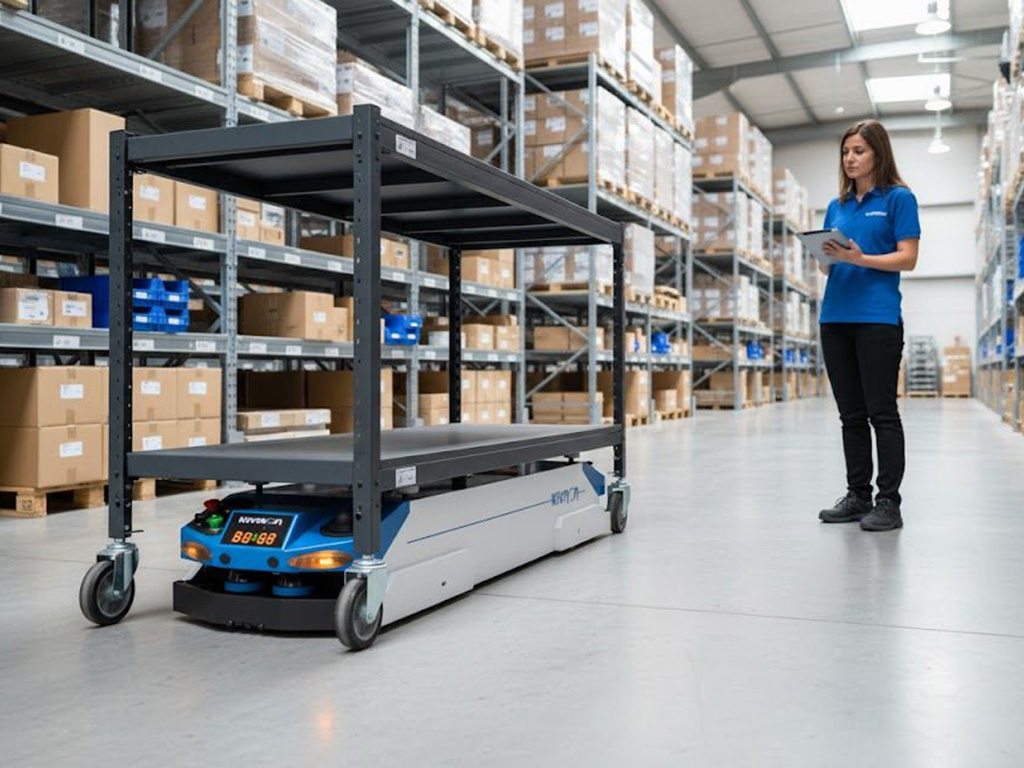
Autonomous Mobile Robots can be configured with a range of navigation technologies to suit different site environments, operational needs, and levels of infrastructure. They can constantly collect information about their surroundings and use software to determine the safest and most efficient route around a facility. They can combine mapping technology, sensors and intelligent software to move through complex environments.
This includes SLAM-based autonomous navigation, magnetic guidance, and QR code navigation, giving customers the flexibility to select the most suitable approach for their facility.
- Simultaneous Localisation And Mapping (SLAM) which allows the AMR to move autonomously by mapping and understanding its environment, reducing the need for fixed infrastructure and making it ideal for dynamic or changing layouts.
- Magnetic navigation provides a highly controlled and reliable route-following system, suitable for environments where fixed paths are preferred and repeatable movements are required.
- QR code navigation offers a cost-effective and structured guidance method, using floor-mounted codes to help the AMR accurately identify its position and follow pre-defined routes.
By supporting multiple navigation technologies, AMRs can be adapted to existing site conditions rather than requiring the site to be built around the robot. This provides greater flexibility, easier integration, and a scalable platform for future operational changes.
Sensors and safety systems
Autonomous mobile robots rely on multiple sensor technologies in order to operate safely. Common technologies include LiDAR, cameras, proximity sensors and ultrasonic sensors, which help the robot understand its surroundings and detect obstacles.
Safety systems continuously monitor the environment and include emergency stop functions. Modern AMRs are designed to slow down, stop or reroute automatically if people, vehicles or obstacles enter their path. This makes them suitable for environments where robots an employees work alongside one another.
Intelligent decision-making
AMRs can do more than simply follow instructions as their software allows them to make decisions based on real-time conditions. Their functions may include route optimisation, traffic management, obstacle avoidance and even task prioritisation. If an aisle becomes blocked, an AMR can calculate an alternative route automatically.
AMRs and AGVs are designed for different levels of flexibility
Autonomous mobile robots and automated guided vehicles are often grouped together, but they operate very differently. An automated guided vehicle (AGV) generally follows predefined routes, and its navigation may be based on magnetic tape, guide wires, markers, or programmed routes. If routes need to change, manual reprogramming or physical alterations may be required.
Autonomous mobile robots are different because they can make navigation decisions independently. They have the ability to select routes, avoid obstacles, adapt to changing layouts and respond to traffic conditions. This makes AMRs particularly valuable in facilities where layouts or workflows frequently change.
Neither technology is inherently better. AGVs remain highly effective for repetitive, predictable transport tasks, whilst AMRs are often better suited to dynamic environments where flexibility is a priority. Many facilities use both technologies depending on operational requirements.
Where autonomous mobile robots are used
Autonomous mobile robots are now being deployed across a growing number of industries. This is because their ability to automate internal transport makes them suitable for a wide range of different environments.
Warehousing and distribution is one of the fastest-growing areas for AMR adoption. Robots transport goods between storage locations, support order fulfilment, assist picking operations and move pallets or containers. This reduces employee travel time and improves operational efficiency.
Manufacturing facilities use AMRs for component delivery, work-in-progress transport, production line replenishment and finished goods movement. This helps maintain production flow while allowing employees to focus on higher-value tasks.
Hospitals use AMRs for pharmacy deliveries, medical supplies, laboratory samples, laundry collection and waste removal. This improves efficiency and reduces the time staff spend on routine transport tasks.
The benefits of autonomous mobile robots
- Improve efficiency in any environment
- Reduce delays associated with manual transportation tasks
- Increase productivity
- Improve safety in working environments
- Provide you with greater flexibility
- Adapt to changing layouts
AMRs can operate continuously with minimal supervision, meaning that they can improve efficiency in any environment. They can reduce delays associated with manual transportation tasks and can ensure that materials arrive where they are needed more quickly and consistently.
They also increase productivity as employees can spend less time moving products around facilities and focus on tasks that require human skills and decision-making. This means that workflows become faster and more streamlined.
AMRs can also improve safety in a working environment as their advanced sensors and safety systems help to reduce collision risks. They can operate safely alongside employees and reduce manual handling activities and their associated risks.
There is also greater flexibility to be enjoyed when using AMRs as they can adapt to changing layouts and operational requirements, unlike fixed-path systems. This means that facilities can modify their workflows without major infrastructure changes giving a flexibility that can support business growth and operational improvements.
Using AMR systems is also extremely scalable, as additional robots can often be introduced as demand increases. Businesses can scale automation gradually rather than making large infrastructure investments all at once, making AMRs an attractive option for organisations looking to automate in stages.
Why autonomous mobile robots are becoming a key part of modern automation
Businesses are under increasing pressure to improve productivity while managing labour shortages, rising costs and growing customer expectations. AMRs provide a flexible form of automation that can evolve alongside operational requirements, working independently or alongside other technologies such as AGVs, conveyor systems, warehouse management software and automated storage systems. The most effective automation strategies often combine multiple technologies rather than relying on a single solution. Therefore, AMRs are increasingly becoming an important part of these integrated automation environments.
Autonomous mobile robots are transforming how materials, products and equipment move through warehouses, factories and healthcare facilities. Businesses can benefit from improved efficiency, greater productivity, enhanced safety and increased operational flexibility. While AMRs are not always a replacement for AGVs, they can provide a powerful automation option for environments where adaptability is essential.
Organisations considering automation should assess how autonomous mobile robots could support their operational goals. With solutions ranging from AGVs to advanced AMRs, Aerocom can help businesses identify the most effective technology for their environment. Contact the team to discuss your requirements and discover how intelligent automation can improve efficiency, productivity, and material flow across your operation.