When it comes to our healthcare system, it always important to find ways to make things more efficient and to save money, and it looks increasingly as though Automated Guided Vehicles might be one way to achieve this. They might sound like things of the future, but they have already transformed a number of different industries and it looks as though the healthcare sector may be the next to benefit from them.
Automation is something which is now entering almost every walk of life through the increased use of things like Artificial Intelligence and so it is important that healthcare settings make use of this in order to offer their patients the very best care that they can. By bringing automation into vehicles in the healthcare industry, we can ensure that many different processes become faster and simpler without compromising on patient care.
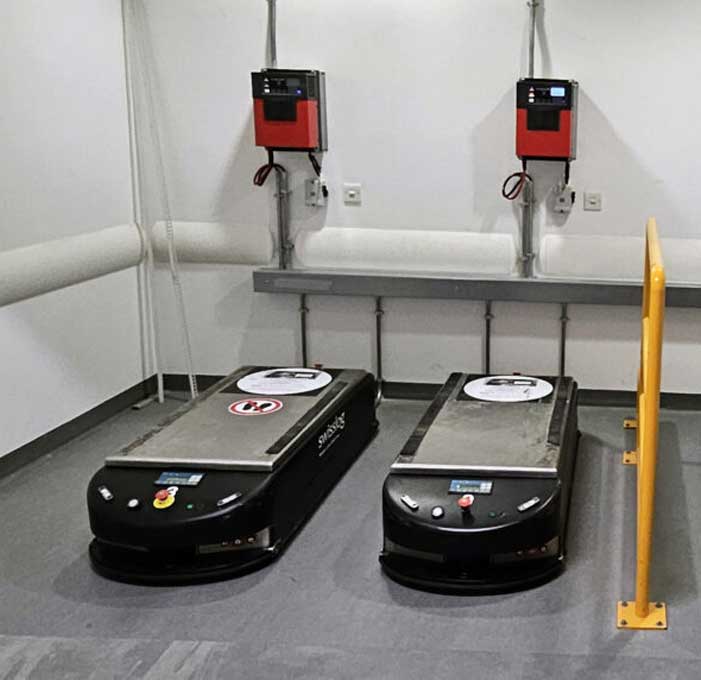
What are AGVs?
An Automated Guided Vehicle (AGV) is a motorised vehicle that can follow a predetermined route through a particular facility without the need for a driver of any sort. They are capable of carrying loads of various sizes and find their way using either markers on the floor, laser guidance or GPS systems, meaning that employees can spend their time doing more important things.
These AGVs do not deviate from their routes, and they have sensors to help them look out for obstacles such as walls, doors and trolleys or people who may be in their path in order to avoid any accidents. Their speeds can be regulated in order to help keep them safe, and they can have dedicated elevators which help them to move from floor to floor if necessary.
AGVs have been employed in many manufacturing sites and warehouses for some time now, and their usefulness and increased efficiencies means that they are now being put to work in healthcare settings to great effect.
The use of AGVs in healthcare settings
There are many jobs in hospitals, care homes and other healthcare settings that require the human touch, but there are also many things that do not, and this is where automation comes in. There are many items that need to be moved around a healthcare facility quickly and accurately, and often the time of nurses and porters are wasted transporting these things instead of caring for patients.
These AGVs run using barcodes and other secure systems so that they know what they are transporting and where it needs to go. This means that important items such as samples and equipment can quickly be moved across a site to their necessary destination, whilst more simple tasks such as storing bed linen, meals, cleaning materials or heavy boxes can also be achieved.
The benefits of AGVs in healthcare settings
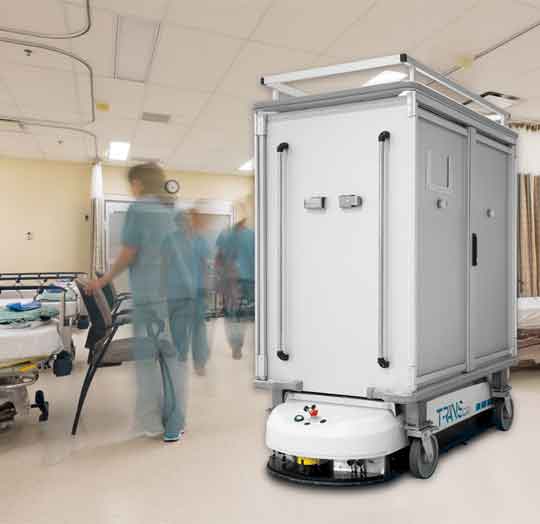 There are many benefits to installing AGVs in healthcare settings, but the biggest one relates to the manpower that it can save.
We are all painfully away of how stretched our healthcare services are, and huge amounts of time are often wasted on jobs that could be done by an AGV.
This means specialist staff can get on with the jobs that they are trained for, and additional staff do not need to be recruited, therefore taking some of the pressure off the budgets as well.
All of this means that patients can enjoy better care, as their healthcare professionals are available to work with them instead of carrying things across departments.
With hospitals now becoming bigger and bigger places, and more individual rooms being set aside, there is a lot more opportunity for human error and tiredness to creep in when manually transporting items from one place to another. By asking an AGV to undertake this role instead, you can be sure of greater levels of accuracy, and no need to be concerned with tired limbs or aching feet.
The COVID-19 pandemic was something which showed us how easily germs and viruses can be spread around different settings, and this is of particular concern in healthcare sites which are full of incredibly vulnerable people. Sending a machine to do a job instead of a human being can help to limit the spread of any viruses or infections, particularly as sanitation and disinfection is much easier.
By having an automated system in place, it is also possible to improve the availability of supplies. With AGVs transporting items around a setting and working to a predefined schedule, it is possible to ensure that everything is fully stocked exactly when it needs to be.
These vehicles are capable of operating 24 hours a day, which means there are no concerns about breaks, shift patterns or downtime and can therefore be used to their full capacity. The battery charging of AGVs has improved greatly in recent years, meaning that they can now run for much longer and require less time to refill their batteries.
Alternative transportation systems
Many healthcare providers have already looked at ways in which they can transport things around their settings. Whilst chutes are often installed to ferry linen or rubbish to different collection points, pneumatic tubes are also commonly used to transport smaller items such as paperwork, syringes, samples and vaccines.
These work by placing the item into a sealed capsule and loading this into a dock. Once the destination has been selected, air is blown through tubes to transfer the capsule from one terminal to another without interference or damage.
Whilst there has been a fear of robots taking over other jobs, the use of AGVs in healthcare settings has shown that rather than making people redundant, they are capable of allowing them to do the jobs that they were employed to do, whilst the automated vehicles take care of the less important menial tasks.
AGVs now give healthcare providers the opportunity to offer greater standards of patient care through staff and material availability and by speeding up certain processes, meaning that rather than being something to fear, AGVs are a way to improve the future for many patients across the world.
Contact Us
If you’re interested in learning more about how automated guided vehicles can benefit your healthcare settings, or if you have any questions about our AGV solutions, get in touch with a member of our team.