Data centres are the 24-hour support for businesses, governments and online activities, and the processing of sensitive information combined with constant operation means that they present a significant fire risk. This not only presents a threat to life and property, but as data centres are critical infrastructure for so many businesses, the consequences of a fire could be extremely far-reaching.
Here, we take a look at the methods of fire suppression that are being used in data centres to help safeguard businesses and all of their essential activities.
What are data centre fire risks?
Data centre fires can have huge consequences as it is not only equipment that risks being destroyed, but also sensitive data and irreplaceable business information. This can lead to a disruption in the operation of the business and some significant financial losses.
The massive amount of electrical equipment in a data centre means that there is a very real risk of components overheating and short circuits occurring. Some equipment might become overloaded through its continuous operation and high energy demands, which can also lead to fires.
With the rising temperatures created by the equipment, there is a risk of cooling failures if the HVAC systems malfunction. As with anything, there is also a risk of human error, which could lead to things like accidental overheating, or the mishandling of devices.
In order to mitigate these risks, it is important that a clean and rapid response fire suppression system is installed. This will help to minimise any risk, prevent downtime and protect sensitive equipment and the information that it deals with.
Why data centre fire protection is important
The data centre is a home to a huge number of servers, networking equipment and storage devices and each one of these can generate large amounts of heat. When this is combined with electrical systems it can lead to catastrophic fire hazards which are potentially extremely damaging for the businesses concerned.
Data is now one of the most valuable assets that a business can hold, and as much of it is irreplaceable, it is easy to see why a fire that destroys the servers holding that data is so devastating. Much of this information is likely to be crucial to the operation of a business and when it is lost, there could be lengthy disruptions. Further downtime could be incurred if systems are taken down by the fire that prevent the business from operating fully.
The cost of dealing with any damaged equipment should also not be underestimated. The hardware included in these types of data centres are extremely expensive and can lead to substantial financial losses if it needs to be replaced.
Losses can be incurred from damage to equipment or downtime, and it is possible to put a price on these. However, one of the costliest aspects of a data centre fire is the reputational damage it can create. An incident like this can erode client trust and damage a company’s reputation for a long time to come. It is hard to estimate the scale of the impact this can have, but it can leave businesses reeling.
This is why there is now a strong emphasis on installing the right fire suppression systems in these data centres.
Water-based systems
Most people know that water and electricity are not a good combination, however, some water-based systems can still be used in overall building protection for data centres. These should be kept away from the areas of the data centre that house sensitive equipment and focused on office or storage spaces instead.
These can include pre-action sprinkler systems that remain dry until a fire is detected and mist systems that distribute fine water droplets to minimise water damage. There are also hybrid suppression systems that combine fine water droplets with nitrogen to inert the atmosphere.
Gaseous clean agent systems
In the areas that house the critical IT infrastructure, it is important to use gaseous clean agent systems. These use specialised chemicals and gaseous agents that are capable of extinguishing fires without leaving behind any residue or causing further damage to the electronic equipment.
The clean agents used can include fast-acting halocarbons that are safe for occupied spaces, environmentally friendly fluids that can vaporise rapidly upon discharge and inert gases such as nitrogen, argon and carbon dioxide that can reduce oxygen levels and extinguish a fire whilst permitting normal breathing.
Passive preventative fire suppression
Often fire suppression systems do not kick in until the fire has had a chance to take hold and be picked up by the sensors. However, there are now small suppression solutions that are specifically designed for confined spaces, like server cabinets and cable trays.
These are self-activating and trigger at much lower temperatures to ensure a more rapid response. They are clean and safe and can detect and suppress fires at the source before they have a chance to spread, therefore minimising the damage that could be caused.
Portable fire suppression systems
It is also possible to install compact and portable fire suppression devices that can offer rapid fire control in data centres. These are easily stored near server racks or monitoring stations and can be moved around to target high risk areas. This means they can be focused on particular areas of concern, even if these change, and can offer quick access during emergencies. They offer a flexible and fast-acting solution and can extinguish a fire in a matter of seconds.
Fire suppression systems should be used to nip the fire in the bud as quickly as possible. This limits its ability to spread and can therefore give data centres the opportunity to limit the amount of damage that is caused, protecting businesses from huge costs, disruption and reputational damage.
It is important to look at the setup of any data centre and identify a combination of suppression systems that can detect fires as early as possible and deal with them to ensure that they are never able to have the devastating consequences that they threaten.
MAUS Fire suppression Systems for Data Centre Fire Safety
Modern fire suppression solutions such as MAUS systems provide a smarter and more adaptable approach to protecting high-risk environments like data centres. Unlike traditional extinguishers or large suppression systems, these compact devices are designed to activate quickly and suppress fires at the earliest stage, often before they have the chance to spread. Using advanced potassium-based aerosol technology, MAUS fire suppression devices absorb heat and interrupt the chemical reaction of the fire, extinguishing it without leaving residue or damaging sensitive electronics.
MAUS EGO Blast: Compact, Standalone Protection
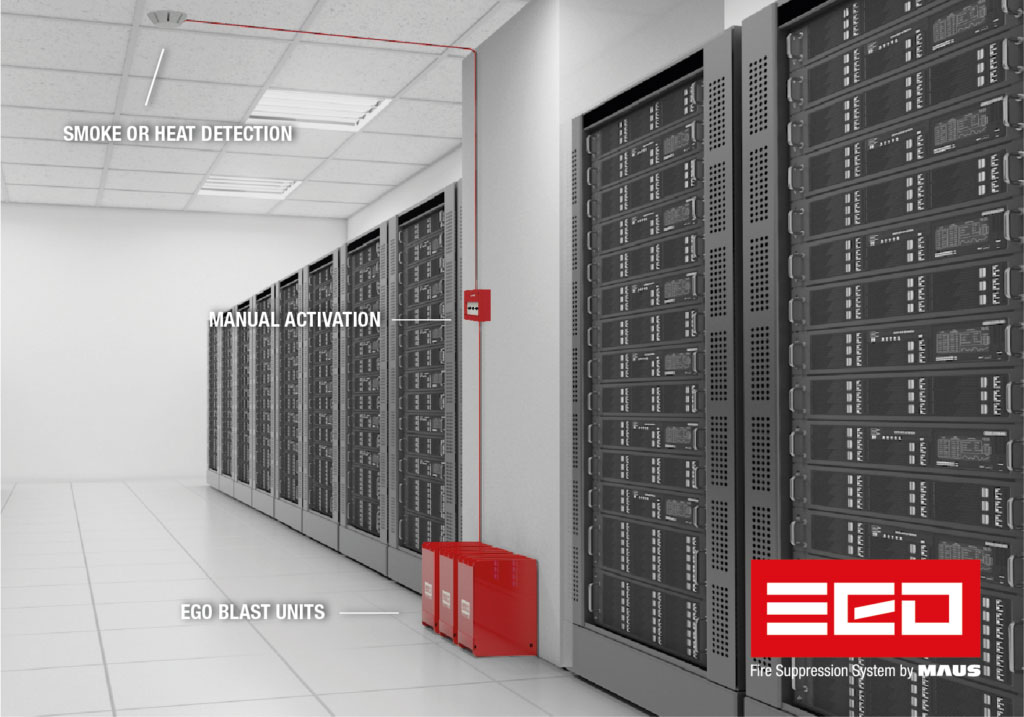
The MAUS EGO Blast is a lightweight, portable fire suppression device ideal for rapid fire control in data centres.
Key Features:
- Compact and Portable
- Easily stored near server racks or monitoring stations.
- Eco-Friendly
- Non-toxic, zero-residue suppression ensures no harm to electronics or environment.
- Fast-Acting
- Extinguishes fires in seconds, minimising damage.
- Versatile Protection
- Effective on fire classes A, B, C, E, and F, covering a range of fire risks.
How to Use MAUS EGO Blast:
Strategic Placement
Position MAUS EGO Blast units near server racks, monitoring stations, or other high-risk areas for quick access during emergencies.
Integrate with Detection Systems
Pair MAUS EGO Blast with smoke or heat detection systems to enable rapid, manual activation when fire risks are detected.
Readily Accessible
Ensure the device is easily accessible to staff or automated systems, reducing response time and maximising fire suppression effectiveness.
MAUS STIXX: Passive, Preventive Fire Suppression
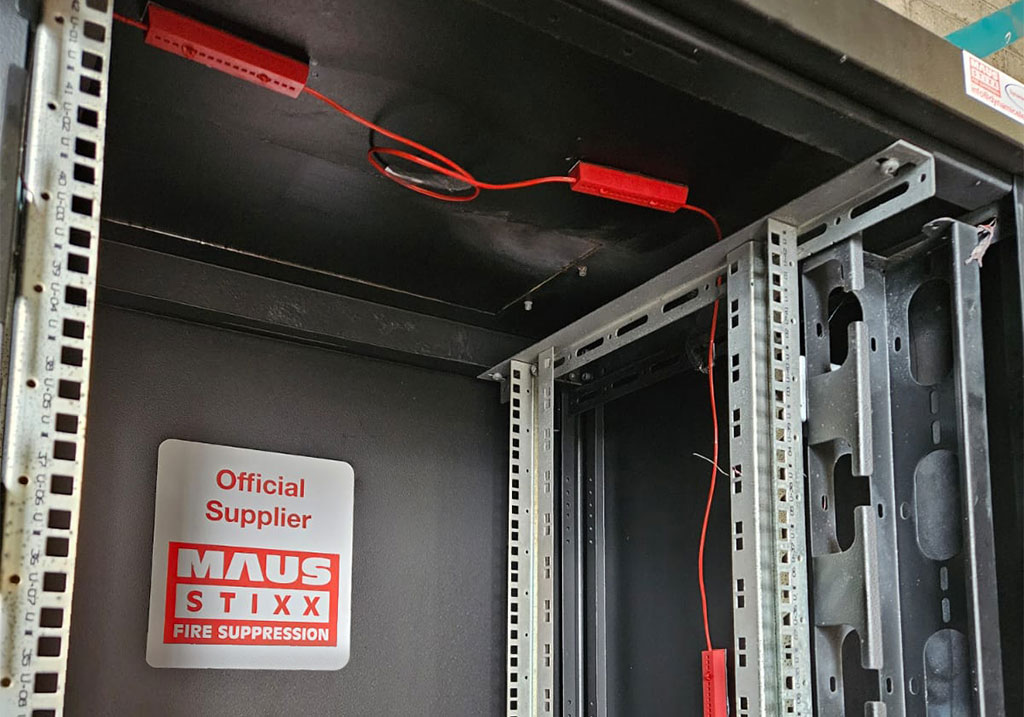 The MAUS STIXX is a self-activating fire suppression solution designed for confined spaces like server cabinets and cable trays.
Key Features:
- Self-Activating
- Triggers automatically at 170°C, eliminating the need for manual intervention.
- Clean and Safe
- Releases a potassium-based agent that with extinguish the fire while not harming electronics.
- Long-Lasting
- Up to 6 years of shelf life and 5 years of maintenance-free operation.
- Space-Saving
- Perfect for compact, high-risk of fire environments.
How To Use MAUS Stixx:
Inside Server Enclosures
Install MAUS Stixx directly within server cabinets to detect and suppress fires at the source before they spread.
Along Cable Trays
Protect power and data cables from fire risks by placing MAUS Stixx along critical wiring paths to prevent fire spread and ensure uninterrupted connectivity.
In HVAC Systems
Safeguard your cooling infrastructure by positioning MAUS Stixx in areas prone to overheating, preventing fire outbreaks caused by HVAC failures.
The Advantage of using MAUS Fire Suppression Systems for Data Centre Fire Safety
- Zero Residue
- No corrosive damage to sensitive electronics.
- Quick Response
- Fast-acting devices minimise operational interruptions.
- Eco-Friendly
- Non-toxic and safe for personnel and the environment.
- Cost-Effective
- Affordable and maintenance-free fire suppression.
- Scalable
- Perfect for small server rooms or large-scale facilities.
Enhance Your Data Centre’s Fire Safety Today
In the fast-paced digital world, downtime isn’t an option. MAUS Fire Suppression devices – MAUS EGO Blast and MAUS Stixx – offer the ultimate fire safety solution for data centres, combining rapid response and prevention without compromising operational efficiency. Protect your data centre with MAUS Fire Suppression. Learn more and secure your fire safety solution today!